






Equal Intercultural Dialogue: The Expedition to England Has Taken Place. Sharing Our Impressions!
Dear friends and readers, Lingva expeditions are more than just travels and sightseeing tours. They are an immersion for every participant into the depths of their own personality. An opportunity to discover the world through the exploration of a foreign culture. Not through textbooks or films, but in real life. Here and now — to learn how to engage in dialogue with representatives of another culture. To find common ground and proudly carry your own cultural identity. To make discoveries and understand exactly how you appear in the world. Under the guidance of mentors, to walk the path toward understanding the world through reflection. To learn to see opportunities where others see problems. The scientific approach based on the communicative method of Efim Izrailevich Passov and the educational science put into practice by Lyudmila Vitalievna Zhuravleva — education professionals since childhood — have for 34 years enabled children and adults, teenagers and kids to create their own unique, accomplished identity!
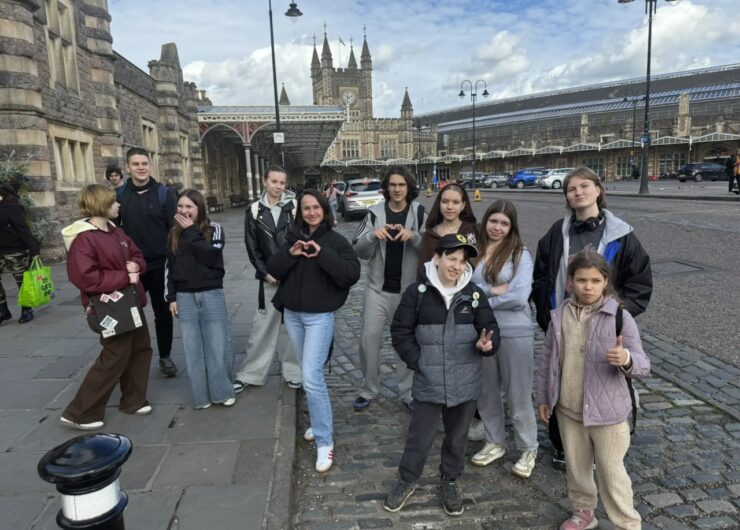
We are sharing something precious — the diaries of our students during their scientific and educational expedition to Chippenham, UK, this spring.
Day One
The first day of our journey began with an unexpected challenge — a flight delay in Moscow. We arrived at the airport full of anticipation and excitement, but instead of a quick start, we faced nearly an hour of uncertainty. This immediately set the tone for the day: it became clear that the trip would require flexibility and patience.
After takeoff, we had a layover in Istanbul and then headed to England. We landed in Bristol tired but inspired. It seemed the difficulties were behind us, but at passport control we faced another new experience: a series of clarifying questions that made us feel a sense of responsibility and mild tension. At this moment, the role of the mentor was especially evident — clear and confident answers helped us get through the control quickly.
A slight worry arose when we couldn’t immediately find the folder with some documents, but thanks to the airport staff’s attentiveness, it was quickly returned to us. This episode showed just how important attentiveness and organization are when traveling.
The following events once again required adaptation: our designated driver couldn’t come due to a bus breakdown. We had to figure out our own route to Chippenham, combining bus and train. Despite fatigue and a lot of luggage, this journey became an opportunity to see the city of Bristol and feel the atmosphere of England from the very first hours.
Especially memorable was a brief encounter with a Russian woman who has lived in the UK for over 25 years. Our dialogue turned out to be unexpectedly objective: she spoke about life without idealization, which helped us see the country more realistically. This was the first reminder that any country is more complex than the stereotypes about it.
On the way to Chippenham, we encountered everyday kindness: people helped with luggage, gave up seats, and offered support. These small gestures created a sense of an open environment and showed that culture is expressed not only in landmarks but also in people’s behavior.
Upon arriving at Springlewood, we gave ourselves time to rest, then went to the store and took a walk around the city. The politeness and attentiveness of the shop assistants also became a notable detail — for some of us, this was an unexpected cultural difference.
The day ended with dinner at a pub. Despite the lack of a reservation and the large number of patrons, we managed to find a spot for the whole group. This became a symbolic conclusion to the day: despite all the difficulties and uncertainties, we consistently found solutions.
The first day showed that the reality of travel differs from expectations — it is more complex, sometimes contradictory, but that is precisely what makes it valuable. We learned that any difficulties can be overcome if we stay calm, act together, and remain open to change. This experience was an important lesson in independence and responsibility.
If educational tours are usually organized by age, our group is mixed-age with a specific pedagogical purpose — to unlock the potential of both the younger and older participants.
Day Two
Today was our first full day in the UK, and we spent it in Chippenham. Honestly, I didn’t expect such a small town to be so convenient and developed. Everything is close by, cozy, peaceful — nothing like big cities. During our walk, many of us bought souvenirs, which added to the feeling that we really are in another country, not just on a tour.
But what I found most memorable was the evening.
Over dinner, a real discussion began — the idea came from Sonya, one of our expedition participants. We debated a question: if humanity achieved immortality, at what age would each of us want to stay forever? Opinions were divided: some chose youth, others chose a more mature age when life experience has been gained. It was very interesting to hear others’ arguments, and the most amazing thing was that some of the participants actually changed their point of view during the discussion. This showed how important it is to listen and be open to new ideas.
Another moment that particularly stayed with me happened during the day. Kira hesitated for a long time to ask about the purple flags on Chippenham’s main street — she felt embarrassed to speak to strangers in English. But Ekaterina and Evgeny supported her, encouraged her, and literally inspired her to overcome her fear. In the end, Kira did approach someone and ask what the flags meant. It was a small but very significant step, and it was wonderful to see how team support helps deal with anxiety.
Why did I personally need this expedition today? For me, it was a chance to step out of my familiar environment, see how people live in another country, and understand the world a little better. And also — to learn how to communicate with different people and not be afraid to express my opinions.
What turned out to be important for me specifically? It was important to feel that even in a new environment, you can adapt quickly. Also — I realized how valuable it is to be able to engage in dialogue and respect others’ points of view. And Kira’s story showed how important support is and how it helps people grow.
Where will this be useful in real life? Probably everywhere: in studies, in future work, and simply in everyday communication. The ability to listen, discuss, support others, and overcome the fear of speaking — these are truly useful skills.
Overall, this day helped us all grow closer and get to know each other better. I am very grateful to my parents for giving me the opportunity to go on this trip — it is truly a valuable experience.
Day Three — A True Reflection and Exploration of Cultures: One’s Own and a Foreign One
Today, March 28, 2026, our day began with breakfast. We had porridge, and after asking many of the others, I realized that everyone found it tasty. From that moment on, a calm and friendly atmosphere prevailed throughout the day.
The second half of the day became even more interesting. First we walked, then took a train to Bristol. Upon arrival, we continued on foot through the city, gradually getting acquainted with its architecture and atmosphere: we saw different streets, beautiful houses, and observed how the urban environment is organized. Moving toward the waterfront, we reached Bristol Marina, where we could feel the more “open” part of the city, connected to the water and the history of the port.
Here we split into teams and went for a walk. We managed to find one of Banksy’s works — “Girl with a Balloon.” It made a strong impression, but at the same time evoked sadness because part of the image had been painted over. This moment showed how much street art depends on people’s attitudes and the passage of time.
After the walk, we headed to the main attraction of the day — the SS Great Britain museum-ship. At the entrance, we were greeted by a magnificent hall with tables set with crystal glasses, stemware, and porcelain plates. This helped us imagine what passengers’ daily life was like and how well-organized the space on the ship was.
Next, we went up to the upper levels of the ship and saw the conditions in which the sailors lived. The tiny cabins were especially memorable — they evoked a feeling of crampedness and even discomfort.
The following exhibits showed daily life aboard the ship and the state of the people during the voyage — they were so realistic that even smells were used to enhance the immersive effect. This created the sensation that you were truly inside a historical environment.
If I draw a brief comparison with Russia, I thought of the cruiser Aurora. That is also a historic symbol-ship, but it is perceived more as a monument and part of an important historical event. In contrast, the SS Great Britain is designed as a “living” museum, where you can literally walk through different spaces and feel the everyday life of people from the past. This difference helps you perceive history in different ways: through a symbol or through immersion.
What did I do? I observed, explored, moved through the city, studied real historical objects, and worked in a team.
What did I feel? Interest, surprise, sometimes discomfort when seeing the cramped cabins, as well as an emotional response to the street art and realistic exhibits.
What did I understand? I realized that history becomes much clearer and closer when you see it not only in theory but also in a space where it “comes alive.” Details, atmosphere, and realism play an important role in perception.
Where will this be useful in life? It will help me navigate new places more easily, develop my powers of observation, work in a team, and gain a deeper understanding of historical and cultural processes.
The day ended with dinner, during which we had an interesting and at times very funny conversation. There we also held a reflection session, sharing impressions and discussing our experiences. This day was an important step for me in understanding how learning can happen through direct interaction with the world around us.
Day Four in England
“Morning dawn. The sun rose over the earth, the forest awoke, admiring the pink glow…” and we awoke with it. 🌸
Entering the main hall, I hurried to help the team member responsible for the dining area, to ensure the work was done on time and in accordance with royal family etiquette. Teamwork here takes center stage. Meanwhile, the rest of the team was busy:
“Breathe in deep, arms out wide,
Don’t rush — one, two, three, four!
Vigor, grace, and plasticity —
Morning invigorating gymnastics!”
Today we had an incredibly appetizing English breakfast that perked us up and gave us energy for the rest of the day. Right after that, we had a lesson in which the group shone with their geographical knowledge, learned about the climate differences between Russia and England, and came to understand: although Russian winters are cold, snow is better than endless rain.
Today we were headed to “the golden city with transparent gates and a bright star” — Bath. The city can be called golden because of the white stone used in its architecture, which makes this place incredibly beautiful and mysterious. In Bath, we had a team quest ahead of us. And although the task seemed easy at first glance, it still took considerable effort to overcome disagreements and, together as a team, reach our goal.
Right after the quest, with a trusty companion by my side, we set off to find an XS hoodie. And although England is considered a country with a wide assortment, we only managed to find the right size in another part of the city. From this, we can conclude that our expectations don’t always align with reality.
We headed back to Chippenham.
“After a hard day comes fatigue, and now all we need is a little rest.”
We sat down to dinner, where we discussed where each of us would like to go. Although there were no set boundaries, almost everyone chose a place that reminds them of good and positive memories. I think this trip will become exactly that kind of place — one we’ll want to return to.
Overall, this day can be described as very successful, dynamic, and helping to strengthen our team.
“That’s the kind of day… that’s the kind of eternal youth.”